Consider this: a threshold is any point where one state ends, and another begins — a doorway, a season change, a birth, a death. Time keeps its own thresholds too, and two of them mark the close of every single day. Dusk is the threshold between day and night. Midnight is the threshold between one day and the next. Across history, these two hours were treated as genuinely different kinds of power, not interchangeable “nighttime” in general. Dusk was protection time. Midnight was connection time. Here’s what that actually looked like, and how to work with both today.
Dusk: The Threshold Between Day and Night
The History
As the sun lowers, you’re standing at the oldest threshold there is. Historically, this hour was protection time, not meditation time, and that shows up across a wide range of cultures.
Ancient Greek and Roman households honored Hecate at crossroads and doorways specifically at twilight, leaving her offerings right as the boundary between day and night opened. Celtic tradition held that the ritual day itself began at sunset rather than midnight — meaning dusk wasn’t an ending in that worldview; it was the actual start of the sacred day.
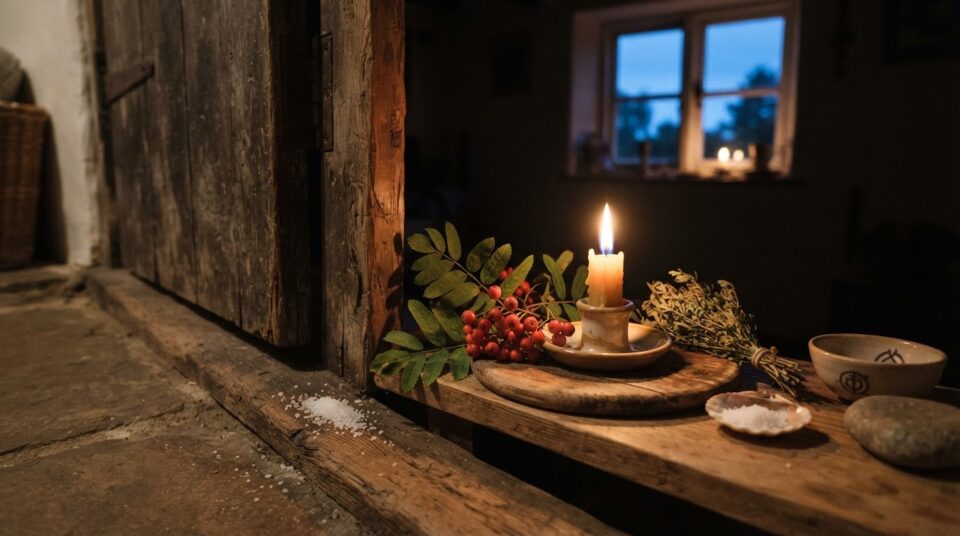
Dusk was also prime working time for witches specifically, because it was considered the hinge point when protective and boundary magic was strongest. Sweeping the threshold at sunset was common — literally sweeping the dust and the day’s residue out the door as the sun went down, symbolically clearing the way before night settled in. Hanging protective herbs over doorways at dusk was another practice: rowan, rue, or St. John’s Wort tied above the door, timed specifically to twilight since that’s when the boundary was considered most porous and needed reinforcing. Salt was laid across thresholds at this hour in various European folk traditions, again tied to that boundary-thinning moment. And lighting a single candle in a window at dusk shows up across a lot of folk practice too, functioning as both a literal guide and a marker saying the threshold is being watched.
Protection work at this hour also went beyond the doorway itself. Iron was a big one — iron nails under windowsills, horseshoes above doors, iron fireplace implements — historically believed to ward off supernatural forces since spirits couldn’t cross it. Apotropaic marks, actual carved symbols like pentangles scratched into doorframes or walls, served the same warding purpose. There was personal warding too — carrying an iron nail, a salt-and-rue sachet, or anointing with a protective oil like rue or angelica before heading into a difficult space — though this post keeps its focus on the home.
Buried protective stones have a real, if thinner, history as well, since working with specific crystal types the way modern practice does is largely a new-age framing. Ancient Egyptians used lapis lazuli and turquoise for protection, both in burial rites and jewelry, and Anglo-Saxon graves show amber, jet, and rock crystal deliberately placed with the body as protective amulets. The closest match to burying stones around a home, specifically, is the hag stone tradition — naturally holed stones hung over doorways and windows across English and Germanic folklore — alongside a broader Irish and European practice of burying protective stones under thresholds and foundations for long-term household defense. Rock crystal is, notably, pretty much quartz, which is the thread this ceremony pulls from.
A Practice for Today: Dusk Home Protection Ceremony
Tools Required:
- Clear quartz
- Smoky quartz
- A small bag
- Paper and pen
- Optional protective herbs of your choosing, or our Lotus line’s ready-made herbal blend
- Optional Lotus line oil or incense.
Step 1 — Create Sacred Space. Cast your circle or otherwise open sacred space in your usual way.
Step 2 — Select and Cleanse. Choose your clear quartz and smoky quartz, place them at the center of your altar, and cleanse them fully — smoke, sound, or your preferred method.
Step 3 — Ask Consent. Hold each stone and ask whether it’s willing to take on this work, standing watch at the threshold through the night. If a stone feels resistant, set it aside and choose another.
Step 4 — Seal the Intention. Wrap the crystals in the bag, adding herbs if you’re using them, along with a written ask — anointed with protection oil if you like. Word it as ongoing: “stand watch at this threshold until called otherwise.”
Step 5 — The Burial. Bury the bag near your door as the sun lowers. Anoint yourself with the Lotus oil, or burn the incense throughout the ceremony, since you’re present the whole time.
Step 6 — Close the Ceremony. Release your circle.
Midnight: The Threshold Between One Day and the Next
The History
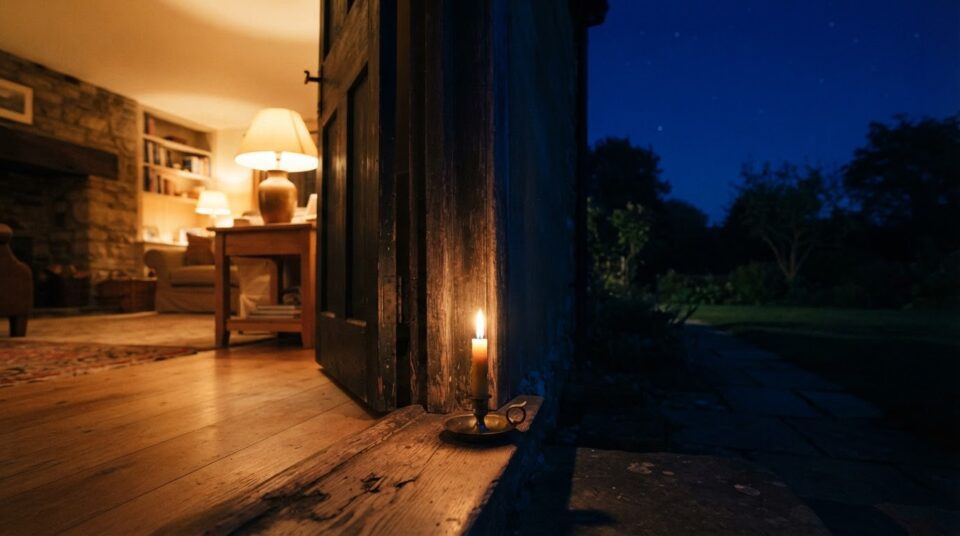
If dusk is the hour for standing guard, midnight is the hour for stepping through. Roman households kept a shrine to Janus, the two-faced god of doorways and transitions, invoked specifically at this turning point in time — though for this post, we wanted something that didn’t require a particular deity.
Looking past that, two solid non-deity threads came up. Medieval monastic communities kept midnight vigils, treating that hour as when things could be heard most clearly because the world had gone silent. There’s also the old medieval European concept of midnight as “the watch,” tied to protection, introspection, and the turning of fate — no gods attached, just the hour itself as a marker.
The deepest thread, though, is spirit contact. Ancient and medieval necromancy practice consistently held midnight — specifically the hour between midnight and one a.m. — as the correct working time, both in Mesopotamian and Greek sources and later medieval European ritual magic, tied to the idea that spirits could be reached once the world went quiet and the veil between the living and dead grew thin. Mirror scrying, technically called catoptromancy, belongs to this same lineage: ancient Greek and Roman diviners used polished metal or reflective surfaces to seek answers from beyond, most famously John Dee, Queen Elizabeth’s court astrologer, who used a black obsidian mirror to communicate with what he called angelic beings.
Witches of old practiced their craft at night for practical reasons as much as mystical ones — privacy and secrecy, since gathering herbs, doing spellwork, or holding community rites away from prying eyes required cover of darkness. Irish folklore also mentions love charms and harm-averting rituals specifically done at midnight.
One more piece of real history worth knowing, handled carefully: flying ointment was historically made from plants in the nightshade family — belladonna, henbane, mandrake, and datura — applied to pulse points, documented from the 15th through 18th centuries. Those plants are genuinely psychoactive and can produce sensations of flight or dissociation, so the folklore of witches flying to a Sabbath likely traces back to real altered states from the ointment itself rather than literal flight. Those same plants are lethal even through skin contact, so this is history only, never a practice to recreate. Modern
practitioners have moved almost entirely away from any hallucinogenic herb; the safe substitute is a ritual bath or anointing oil with non-toxic aromatic herbs, giving that same sensory, altered-state, boundary-crossing experience without any poison risk. That arc — real history, then what it evolved into — is exactly what the modern practice below draws from.
A Practice for Today
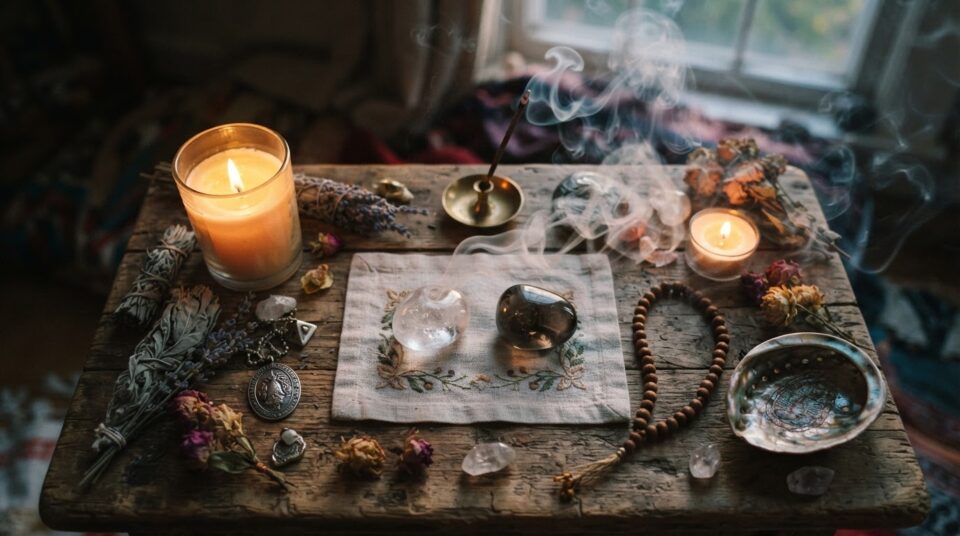
Tools Required:
- An item representing the spirit you wish to connect with — an animal shape, a family lineage token, or a deity statue or photo
- A journal and pen
- Drumming or rattling music
- Optional Lotus line oil, smokable blend, or bath salts.
This practice draws on that same hour through shamanic journeying — intentionally traveling to meet a guide, an ancestral lineage, or a deity, rather than passively waiting for a sign.
Step 1 — Prepare. By preference: anoint forehead, heart, and both wrists with the Lotus oil, smoke the smokable blend, or take an intentional bath with the bath salts to open yourself up before beginning.
Step 2 — Set the Scene. Create sacred space, then place your chosen representation of the spirit at your altar.
Step 3 — State Your Intent. Lay down or sit before the altar and say your question and intention out loud before you begin.
Step 4 — Begin the Journey. Start your drumming or rattling music. Once you reach the threshold of the lower world, state your intention a second time.
Step 5 — Journey and Return. Do the work of the journey, then return.
Step 6 — Record It. Write down everything you experienced in your journal. This can be repeated nightly or every other night if you’re working toward connecting with a specific spirit.
New to journeying? Read the full how-to here:
Consider this your invitation to work with both hours — the one that protects and the one that connects!