For centuries, sound has been used as a tool for healing and meditation. Today, crystal singing bowls and tuning forks are two of the most popular ways to bring that practice into your own home. But with popularity comes a lot of noise (pun intended). So in this post, we’re separating three things: what’s scientifically supported, what’s practitioner wisdom passed down through training and hands-on experience, and what’s an unsubstantiated claim you’ll see floating around the wellness internet. All three have a place — but you deserve to know which is which.
Part One: Crystal Singing Bowls
The General Benefits: What the Research Actually Shows

Before we get into mythbusting specific frequencies, it’s worth grounding this in real, peer-reviewed evidence for sound healing broadly. A 2025 systematic review of 14 studies on Tibetan singing bowls found they were linked to reduced anxiety and depressive symptoms, increased heart rate variability, and decreased heart rate (DOI: 10.3390/healthcare13162002). A 2016 observational study of 62 participants found significant reductions in tension, anger, fatigue, and depressed mood after a singing bowl sound meditation — and interestingly, people new to it saw even bigger drops in tension than experienced practitioners (DOI: 10.1177/2156587216668109).
A couple of honest caveats worth naming. First, these sessions were mostly guided and live, led by trained practitioners playing a mix of Tibetan bowls, some crystal bowls, gongs, and bells together — this is evidence for the category broadly, not isolated crystal-bowl research. Links to both studies are above if you want to read the full research yourself. Second, the systematic review didn’t cleanly isolate live playing from recorded playback — it mixed contact and non-contact methods along with some pre-recorded sessions, so it doesn’t prove live sessions outperform recordings. That live sessions matter more, because of the full-body vibration you only get in the room, is a reasonable extrapolation grounded in how these bowls work — but it’s practitioner belief, not something these specific studies proved (more on that below).
With that real evidence as our foundation, let’s get into the specifics — starting with the frequency debate everyone gets stuck on.
Mythbust: The 432 Hz vs. 440 Hz Obsession
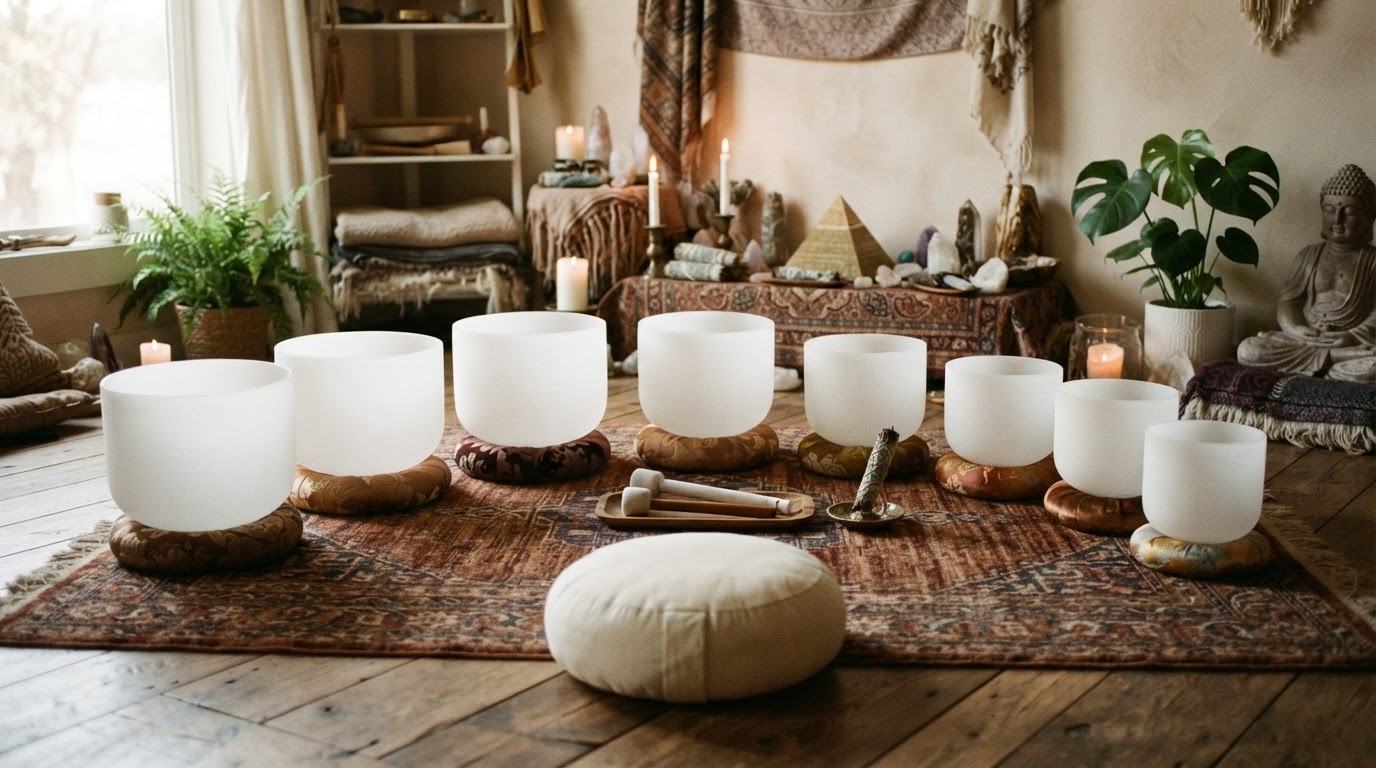
You’ve probably heard that bowls should be tuned to 432 Hz because it’s the “natural” or cosmic frequency, versus 440 Hz being some kind of imposed, unnatural standard. Here’s the actual history: 432 Hz was proposed back in 1713 by French physicist Joseph Sauveur, as a mathematical reference point — nothing spiritual about it. It was later adopted by Verdi in 1880s Italy for a very practical reason: protecting opera singers’ vocal cords from pitch creep, since orchestras kept tuning higher and higher over time.
440 Hz wasn’t chosen for any acoustic or health superiority either — it became the international standard in 1939 mainly for the sake of having one, so instruments and orchestras worldwide could agree. And the popular claim that the Nazis imposed 440 Hz to suppress consciousness or “shut down the heart chakra”? That’s misinformation. It’s been thoroughly debunked and has no historical basis.
So the real story on 432 is grounded in physics and vocal health, not cosmic alignment: it’s measurably easier on the human voice. And if you extrapolate that out, a frequency that’s gentler on the vocal cords is a reasonable argument for being gentler on the body as a whole. That’s a different claim than “432 is nature’s true frequency” — but it’s an honest one, backed by real reasoning instead of manifestation language.
This matters because of what it says about the current trend toward higher and higher frequencies in sound healing circles, often paired with “you just have to get used to it” when something feels uncomfortable. If a tool is supposed to align naturally with your body, you shouldn’t have to force yourself to tolerate it. That discomfort is information, not a threshold to push through.
The Precision Trap
You’ll see bowls marketed with claims of ultra-precise tuning — and sellers charging a premium for a bowl measured at exactly 432.000 Hz versus one at 430 or 434. Here’s the thing: the human body isn’t a light switch. It works in degrees. Even moving up a musical scale isn’t a hard line where one note ends and the next begins — it flows gradually. Chasing hyper-precise tuning is chasing a standard the body was never built to need. It’s a pricing gimmick more than a meaningful difference you’ll actually feel.
Chakra Note Mapping
This is a widely used framework linking musical notes to the body’s energy centers:
- C — Root Chakra
- D — Sacral Chakra
- E — Solar Plexus Chakra
- F — Heart Chakra
- G — Throat Chakra
- A — Third Eye Chakra
- B — Crown Chakra
This is a helpful framework for choosing bowls and forks with intention — not a rigid rulebook. Which brings us back to the precision point above: work with the note that resonates, not the decimal point.
Crystal Bowls vs. Metal Bowls
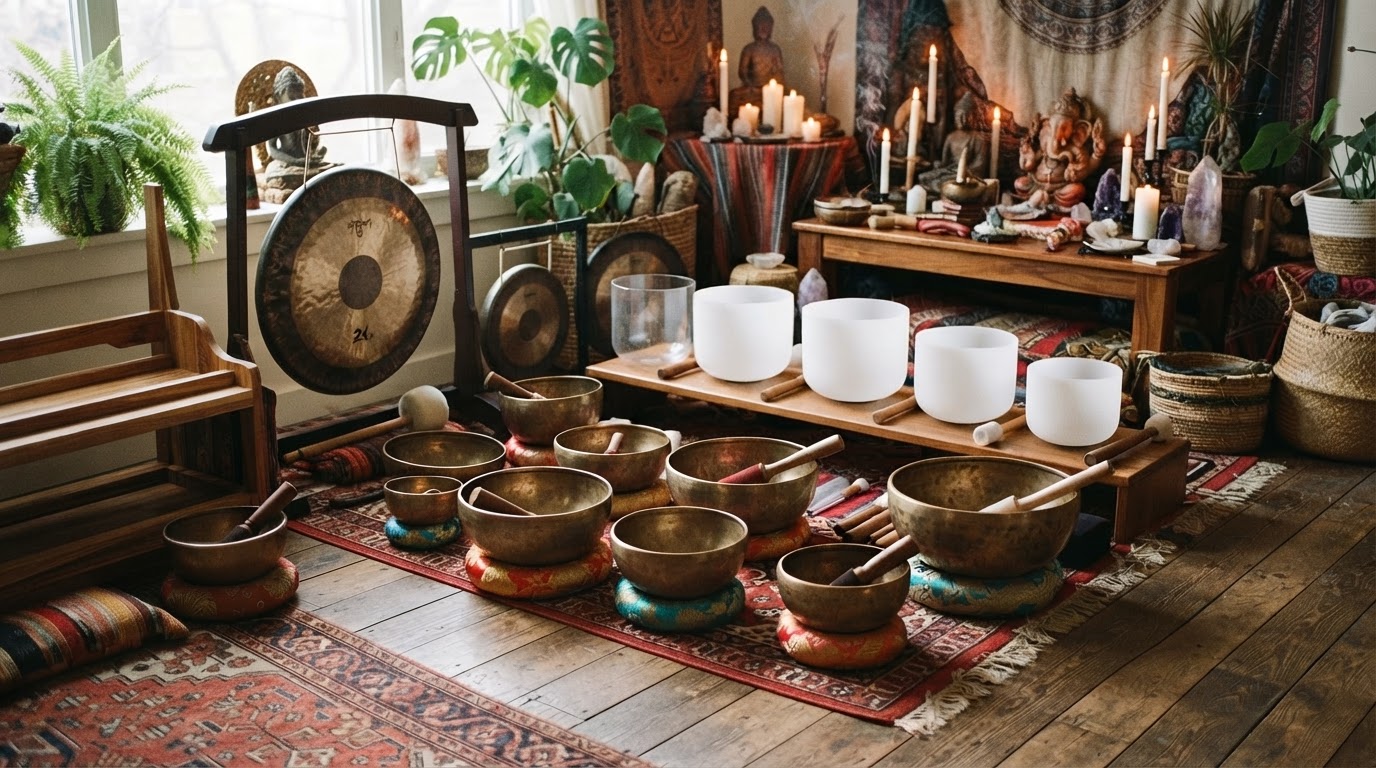
Crystal bowls and metal (often called Tibetan) bowls behave very differently. Metal bowls carry more overtone complexity and are traditionally played with a variety of mallets — skilled players typically work with a handful of bowls (three or four) alongside a much larger mallet collection (seven or eight), using different mallets to pull different tones and overtones out of the same bowl. That mallet-to-tone relationship is real and documented; the exact “handful of bowls, many mallets” ratio is drawn from watching experienced players, not a formal statistic.
Metal bowls take real skill to play well, and that’s exactly why crystal bowls are our starting recommendation and personal preference here at Raven Moon: a clean, singular, sustained tone that’s far more forgiving for someone building their practice.
Practitioner Experience: Live vs. Recorded
Scientifically, there’s no clean distinction between the two — both live and recorded sessions were used in the research above, and the studies didn’t isolate one from the other. That said, in Raven’s own practitioner experience, she’s seen more benefit from being in the room with a bowl played live than from listening to a recording, due to the full-body vibrational bath you only get in person. Recorded sound bath tracks still have value, but this is Raven’s own observation from years of hands-on work, not something the research itself has proven.
Safety Note: Crystal Bowls and the Body
A crystal bowl should never be placed directly on the body — there’s a real shatter risk. Only metal or Tibetan bowls are used for on-body placement.
Part Two: Tuning Forks
Tuning forks work differently than bowls: instead of a musical scale reference, each fork is built to one exact frequency. The Ohm fork, for example, is tuned to 136.1 Hz — linked to the heart chakra and the musical note F, as covered above.
Weighted vs. Non-Weighted
Non-weighted forks project vibration outward from the tines, so they’re used around the body and in the energy field — never touching the skin. Weighted forks channel vibration down through the stem, so they’re placed directly on the body, working through bone conduction.
Generally speaking, the lower the frequency, the better it works when placed directly on the body.
Non-Weighted Forks
The Binaural Brainwave Set: Relaxation vs. Aura Claims
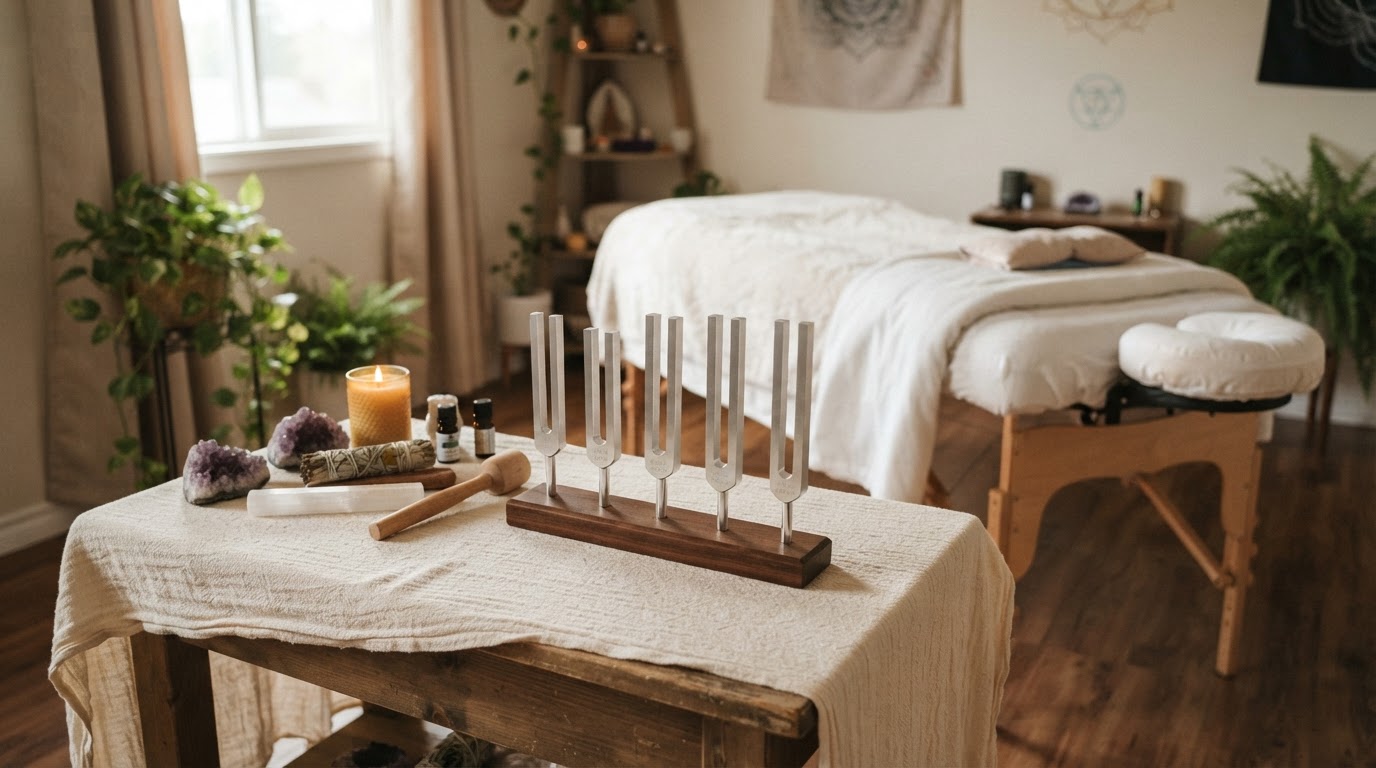
Binaural tuning fork sets — placing one fork at each ear to create live binaural beats — come with two very different kinds of claims. On relaxation, the evidence is genuinely mixed but leaning real: some peer-reviewed research supports binaural beats nudging brainwaves toward theta and delta states associated with relaxation, though the mood-improvement evidence specifically is thinner and less consistent. Modest, but real.
On the claim that these forks “align the aura” or energy field: there’s no credible evidence behind that at all. It’s an unfalsifiable, spiritual claim rather than a measurable one — worth naming clearly so you’re not paying for a mechanism that isn’t there.
From practitioner experience: Raven has worked with this set of tuning forks with clients and has noticed it helps with relaxation and with reducing brain fog and mental clutter (“brain pollution”). This is not a studied claim — it’s practitioner experience built from direct work with clients, offered here alongside the research above rather than in place of it.
The 528 Hz Nuance
528 Hz gets marketed as the “DNA repair” or “miracle” frequency. Those claims are thoroughly debunked — there’s no peer-reviewed evidence behind them. The idea actually originated in numerology and spiritual writing, not in genetics or biology research.
That said, there is one legitimate, relevant study worth citing: a 2025 randomized controlled trial with 60 hypertension patients, published in the journal Annals of Neurosciences. Participants in the intervention group listened to Om chanting specially composed at 528 Hz for 15 minutes daily over one month. Compared to the control group, they showed a significant reduction in pulse and blood pressure, along with improved heart rate variability, psychological wellbeing, and sleep quality. Important caveat: this is Om chanting — a vocal meditation practice — not a singing bowl, so the benefit likely comes from the meditative practice itself rather than the specific frequency. Still, it’s an honest, evidence-based answer to point to, rather than dismissing 528 Hz outright. You can read the study here: PubMed / free full text (PMC).
Weighted Forks
Mythbust: Where “Otto” Comes From
People often assume the Otto series of forks is named after a person — “Dr. Otto.” It’s not. “Otto” is short for “osteophonic,” meaning bone-vibrating, which describes exactly how the fork works. The Otto series comes in 32 Hz, 64 Hz, and 128 Hz.
The Nitric Oxide Claim: Practitioner Claim, Not Peer-Reviewed Science
You’ll hear a specific claim repeated often in sound healing circles: that the Otto 128 Hz fork spikes nitric oxide production in the body within about 30 seconds. This traces back to around 2002, to Dr. John Beaulieu (co-creator of the BioSonics fork brand) and researcher George Stefano, who tested the claim through a company called Cell Dynamics. This is practitioner-level insight from people with real hands-on experience in the field — but it hasn’t gone through the peer-review process the way it’s sometimes implied to have. We’re presenting it honestly, filed under practitioner claim, not scientific fact.
Vibrational Healing with Weighted Forks
There’s no direct clinical study on weighted tuning forks specifically, but it’s worth grounding this in the broader research on vibration and health first. Whole-body vibration platforms — the standing “vibration plate” machines — have their own dedicated research base: a 2013 study in Annals of Rehabilitation Medicine and a 2023 review of 14 studies (published in the Journal of Orthopaedic Surgery and Research) both found real improvements in pain and function for knee osteoarthritis and chronic lower back pain. A 2026 systematic review found gains in lower-body strength and balance in older adults, though the evidence is inconsistent. And a 2023 systematic review found evolving, still-thin evidence that whole-body vibration may support cognitive function.
Note: this research was conducted with full-body vibration plates, a completely different delivery mechanism than a handheld tuning fork — a standing platform vibrating the entire body versus a localized point of contact. Tuning forks work on a similar underlying principle, but likely deliver less of a benefit than full-body platforms, since the vibration is more localized and less intense.
Beyond that whole-body research, broader vibration therapy research does support a plausible mechanism specific to joint work: vibration can reduce synovial fluid viscosity, improve blood flow, and reduce inflammation in joints. Separate research supports vibration for sinus and facial pain relief — a scoping review found vibrational stimulation effective for sinus pain, and clinical studies on an acoustic-vibration device (SinuSonic) showed real short-term relief from nasal congestion and facial pressure. This is vibration-device and joint-vibration research, not tuning-fork-specific — but it’s real, cited evidence, not an assumption, and it lines up with what we see in practice.
From practitioner experience: building on that same mechanism — reduced synovial fluid viscosity, improved blood flow, and reduced inflammation — Raven has found in her own practice and with her clients that weighted tuning fork work can help ease joint pain, inflammation, and swelling. This is practitioner observation drawn from hands-on sessions, not a claim backed by a fork-specific clinical trial.
Chakra Tuning Fork Frequencies
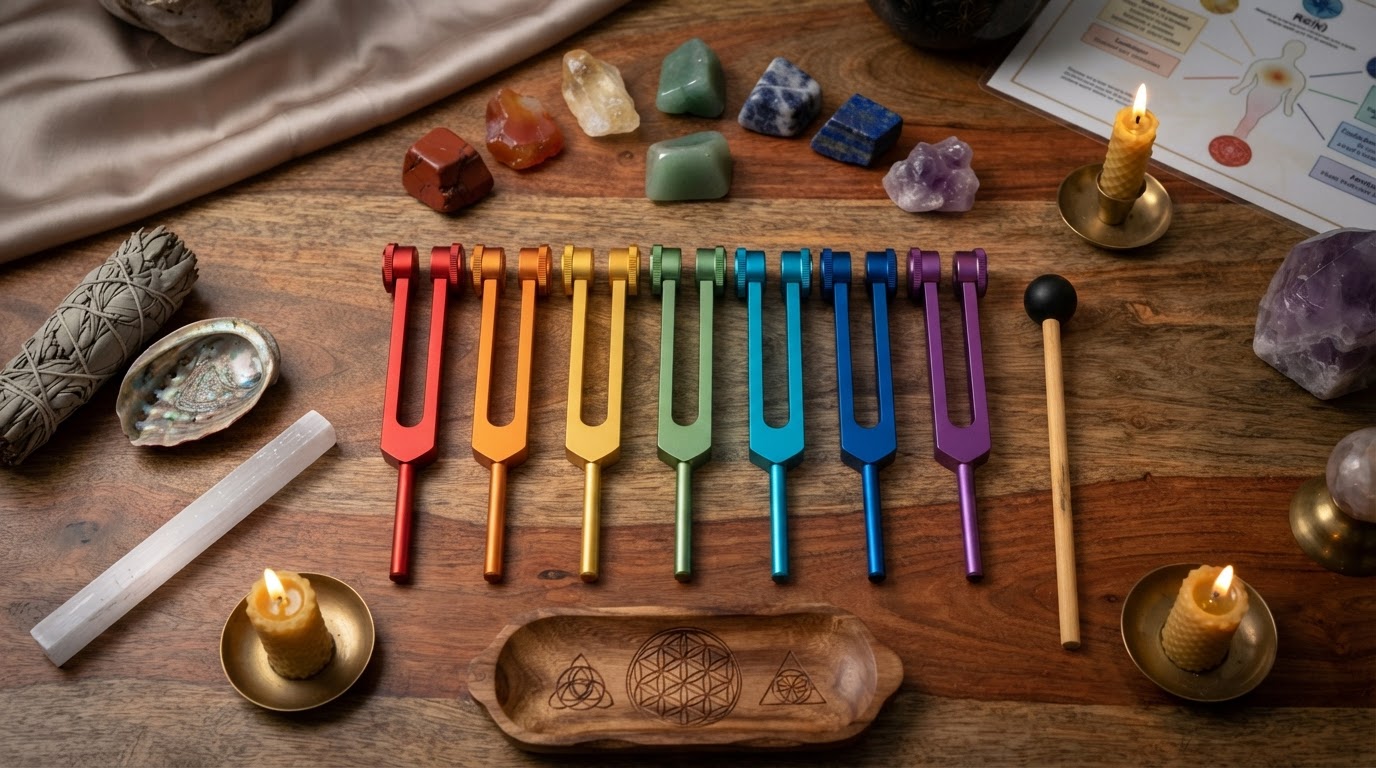
There are many different claimed systems for which frequency corresponds to which chakra — you’ll find competing charts across the sound healing world, some based on Solfeggio numbers, others on planetary correspondences, with no single universally agreed-upon standard. The most commonly used system, and the one we work from, runs like this:
- Root — 194.18 Hz
- Sacral — 210.42 Hz
- Solar Plexus — 126.22 Hz
- Heart — 136.10 Hz (the OM frequency)
- Throat — 141.27 Hz
- Third Eye — 221.23 Hz
- Crown — 172.06 Hz
Getting Started
If You Want One Fork to Start
Start with either the 136.1 Hz Ohm fork or the Otto 128 Hz fork — both are excellent entry points, and many practitioners (including us) like to use them together.
If You Want the Full Chakra Set
Our Chakra Weighted Tuning Fork Set covers all seven chakras, root through crown. This is the set Raven herself uses for all of her vibrational healing sessions. In practitioner experience, this set is well suited to chakra balancing work — framed here clearly as practitioner experience, not a scientific claim.
For Binaural Work
This is the exact set we use for binaural work: Brain Tuners Set of 5 from Sound Therapy Shop. We don’t carry this one ourselves, but it’s where we sourced our own set — this is the same set Raven personally uses in her own sessions.
Body Placement Notes (Metal/Tibetan Bowls & Weighted Forks)
Two effective placement points for on-body Tibetan bowl work: the root-sacral junction, and the heart-solar plexus junction. On bowl size, a minimum of 7 inches in diameter is needed for someone to actually feel meaningful vibration — smaller bowls (5 inches and under) generally don’t deliver enough. Weight and material seem to matter more than size alone; both seven-metal alloy and brass bowls perform well.
Safety Notes
- Crystal bowls are never placed directly on the body — shatter risk. Only metal or Tibetan bowls go on-body.
- If you have osteoporosis, low bone density, or bone density affected by chemotherapy, talk to your doctor before weighted tuning fork work or on-body bowl placement, since both rely on bone-conducted vibration.
- You’ll hit diminishing returns on a weighted fork after about four applications to the same area of the body (roughly the 15-minute mark) — additional striking past that point isn’t adding benefit.
- Full benefits described here assume live, in-person sound work — not a recording.
Sound healing sits at an interesting crossroads: real physics, real practitioner wisdom built over years of hands-on work, and a lot of marketing noise dressed up as fact. Our goal with every tool we carry is to help you tell the difference — so you can build a sound practice around what actually works for you, not what sounds good in a sales pitch.