Evening gets sold to us as wind-down time. Candles, tea, a warm bath, lights low — relax, and go to sleep. That’s not wrong, exactly, but it’s incomplete. Evening isn’t just the end of the day slowing down. It’s a threshold: a doorway between one state
and another. Some nights may not be about rest and relaxation at all — they may hold something more magickal, even mystical.
And there is nothing more mystical than our dreams. For generations, mystics and scholars alike have worked to decipher them — to understand what dreams actually are, and what’s really happening while we’re in them. Over the years, that work has produced a whole range of methodologies, not just one tidy answer.
It’s also one of the most common questions we get in the shop: how do I interpret my dreams? How do I control them? How do I even start remembering them? So this week, we’re answering those questions — starting with the four distinct
practices that live under the umbrella of dream work: lucid dreaming (knowing you’re dreaming while you’re in it), dream walking (doing active healing work once you’re lucid), spirit messages (receiving guidance through a dream, with or without asking for it), and dream gatekeepers (a spirit who guards your dreams, whether from nightmares or just to give you a real night off). We’ll go through all four, then get into how to actually start working with this yourself.
Lucid Dreaming
Lucid dreaming is an umbrella term, and it means less than people think it does: it’s simply knowing you’re dreaming while you’re still in the dream. That’s it. That single shift in awareness gives you some ability to navigate or take charge of what’s happening — not total control. Even with years of practice, mastering lucid dreaming doesn’t mean directing every detail of the dream; it means having options you didn’t have before.
Lucid dreaming can happen on its own, or it can happen alongside other kinds of dream work — it’s often the doorway that other practices walk through, like dream walking, which we’ll get to. But it’s also a complete practice by itself. This distinction matters because the modern spiritual-wellness version of lucid dreaming has drifted far from what it actually is. The popular version blurs lucid dreaming together with astral projection, and then adds manifestation on top — “manifest your dreams into physical reality. That framing shifts the entire point of the practice: away from awareness and service, and toward personal gain and total narrative control. It collapses three genuinely distinct practices — lucid dreaming, dream walking, and astral projection — into one blurry idea that loses what makes each useful.
The bare-awareness definition isn’t a modern invention or a new-age softening — it has real lineage. It matches the scientific definition of lucid dreaming (the framework established by dream researcher Stephen LaBerge), and it also matches Tibetan dream yoga, known as milam, which draws the same line: bare lucidity is one layer, and active dream practice built on top of that lucidity is a
separate, further layer.
How Lucid Dreams Develop
Some people are simply born with it. For me, it came naturally as a child, without effort — what took real development wasn’t the base awareness itself, but control: learning to do things like waking myself up mid-dream when needed.
But you don’t have to be born with it. Tibetan dream yoga treats lucidity as trainable, through two practices that reinforce each other: strong intention-setting before sleep, specifically the intention to recognize when you’re dreaming, and a daytime practice of treating waking perception itself as dream-like — questioning what’s real while you’re awake, so the habit of questioning carries over into sleep. Traditionally, this wasn’t casually self-taught; it was passed down formally, from teacher to student, within a lineage.
That points to something else: a spirit guide can act as a teacher, training a person in the skill of lucid dreaming itself over time — distinct from a spirit simply delivering a one-time message or visitation dream (that’s a different practice, dream incubation, which we’ll cover under spirit messages below). This teacher framing isn’t a stretch or a new-age add-on. It sits within real shamanic tradition — ethnographically documented across Siberia, the Americas, Africa, and Australia — dating back an estimated 20,000 to 30,000 years, in which spirits — not the human practitioner — are traditionally understood to be in charge of the dream journey. That’s worth sitting with: it’s the opposite power dynamic from the modern self-control framing of lucid dreaming. The dreamer isn’t the one running the show. The spirit is.
Dream Walking
My grandmother used the term dream walking, and it’s distinct from lucid dreaming itself, even though it depends on it. Dream walking is the active healing-work layer built on top of lucidity: while aware you’re dreaming, you travel — to other people, other places, other worlds — and do healing or diplomatic work there.
What that’s looked like for me: holding emotional space for someone in a dream conversation, sitting across from them at their kitchen table while they work through something. And, at the more expansive end, being brought into an interplanetary dispute — a mining dispute — to help settle it. I hold these as metaphors for whatever real energetic work is actually happening, not as literal events to take at face value. The content of the dream is doing translation work;
the work itself is real.
This isn’t a fringe idea I invented. The formal anthropological term for it is “soul flight” or “magickal flight,” and it’s documented from Paleolithic times to the present: the shaman’s spirit or dream body travels to find a lost soul, intercede on someone’s behalf, or negotiate with a disruptive spirit to restore balance for the community. That’s dream walking, structurally, almost exactly.
One important distinction: dream walking is not the same as shamanic journeying. Journeying is drumming- or trance-induced, done wide awake, with volitional control the whole way through — phenomenologically a different state. Dream walking specifically occurs during sleep, within the dream state itself. They’re both real practices; they’re just not the same practice.
The new-age flattening that happens here is the same one that happens to lucid dreaming: dream walking gets folded into “astral projection” or “soul travel,” commercialized, and reframed as individual consciousness expansion rather than
communal service. The tradition it comes from is about doing something for someone or something else. That’s the piece worth protecting.
Spirit Messages
This is a different kind of dream work entirely, and we need to separate it clearly from the two above: spirit messages don’t require lucid dreaming at all. Sometimes this looks like petitioning — asking a specific spirit or ancestor a direct question and requesting the answer arrive through a dream. That’s an old practice with real lineage: Egyptian, Greek, and Assyrian traditions all include petitioning a deity or spirit for a visitation dream that carries guidance, a formal practice called dream incubation.
But messages don’t always come because you asked. Just as often, they arrive unbidden — the answer to a question you asked somewhere else entirely in your spiritual work simply shows up in a dream, without a specific dream-petition attached to it. Both are valid paths into this practice: actively petitioned, or freely given.
The key structural point here is that receiving a message is a receptive act, not an active one. You don’t need lucidity or dream control to benefit from it — you just need to remember it. That’s what separates spirit messages from lucid dreaming and dream walking, which both require active awareness while you’re in the dream.
In my own practice, this happens most often through ancestral work, specifically, asking an ancestor a question and receiving the answer in dreamtime. That will likely be the most common channel for most readers, too.

Dream Gatekeepers
A dream gatekeeper is a spirit asked to guard or screen your dreams. The clearest use case is for people dealing with recurring nightmares or true night terrors who want them to stop.
Let’s be clear about what this practice is actually for, because two things get confused all the time: night terrors and sleep paralysis. True night terrors happen during deep non-REM sleep — the person isn’t really conscious during the episode,
and sometimes may even have no memory of it afterward. Sleep paralysis is different: the person is consciously aware, but the body’s REM muscle-paralysis mechanism carries over into a waking or half-waking state, often accompanied by hallucinations of presences or figures. Sleep paralysis is a physiological, neurological event — it’s REM atonia leaking into wakefulness — not a spiritual or dream-space problem. A dream gatekeeper isn’t the right remedy for it. Gatekeeper work belongs to true night terrors and nightmares happening within actual sleep, but they can also sometimes help with sleep paralysis.
There’s a second, entirely different use for a gatekeeper, and it’s one I use myself: opting out of dream walking on a given night when I’m tired. Dream-walk work comes in waves — sometimes months with none at all, sometimes two straight weeks where every single night is a dream walk. The body and mind don’t get to rest during active dream-walk work the way they do during ordinary sleep. On the nights I need real rest instead, I can ask a gatekeeper to hold off a dream walk for the night.
This practice has real historical and cultural precedent, not a new-age invention. The Japanese Baku is a nightmare-devouring spirit, traditionally summoned by name before sleep, or called on after a bad dream specifically to eat it. The Greek Oneiroi are dream spirits who pass through specific gates, and Epiales is a nightmare-specific spirit in that same tradition. Core shamanic traditions broadly include guardian spirits that protect the dreamer from harmful spirits. All of these share a structure: a specific, named being with a specific job. That’s different from the modern new-age version — generic “energy shield” or light-visualization language, a vague spirit guide protecting against unspecified “psychic attacks.” Diffuse and self-directed, instead of specific and relational.

Bringing This into Your Own Life
Once you know the four shapes dream work can take, the natural next question is how to actually start. Below is the first of what will be a short set of practices — ways to work with this material directly rather than just understand it.
Dream Recall Ceremony (a 21-day plant practice)
This is the starting point, because most of the practices above depend on it: none of it matters if you don’t remember your dreams. If dream recall isn’t happening naturally, this is a way to build it deliberately, using the same underlying method as the message-receiving and recall work above — a small ceremony, paired with partnering with a spirit for help. Here, the spirit partner is specifically the spirit of a dream herb: a plant that serves as a teacher, guiding you to remember your dreams.
- Pick one dream-associated plant to work with for the full 21-day period.
- Set up a small, temporary altar for that plant.
- Consume the plant before bed each night for 21 days, treating it as a working relationship with the plant’s spirit — not just an herbal supplement — and asking it directly for help with dream recall.
- Make sure the plant is safe to consume internally before you do so.
On the 21-day period specifically: 21 is a number I’m personally drawn to and work in generally — not necessarily because of documented esoteric backing, but it holds up when you look: 21 = 3 × 7, and both 3 and 7 are independently sacred numbers across many traditions (3 as trinity/creation, 7 as a cosmic cycle or completion), giving 21 a cross-cultural “full cycle” meaning. Concretely, Hindu tradition uses 21-day periods for purification after certain transgressions, and Tibetan Vajrayana Buddhism traditionally prescribes reciting specific mantras 21 times as a set practice count.
Dream herbs (for cultural/historical context; not all are sold in the shop):
- Mugwort (Artemisia vulgaris) — moon-associated, the classic dream herb.
- Guayusa (Ilex guayusa) — used ceremonially by the Kichwa people of the Ecuadorian Amazon as a dawn dream tea, since at least 500 AD (contains caffeine).
- Marshmallow root (Althaea officinalis) — moon/water-associated, traditionally placed under the pillow for prophetic dreams and recall.
- Mexican dream herb (Calea zacatechichi) — used by the Chontal people of Oaxaca for dream divination.
- African dream root (Silene capensis) — used by Xhosa shamans of South Africa to access ancestral wisdom through dreams.
- Poppy seeds (Papaver somniferum) — sacred to Hypnos and Morpheus in ancient Greece; used at the temple of Asclepius for dream therapy.
- Blue lotus (Nymphaea caerulea) — used in ancient Egypt for ceremonial trance work believed to facilitate communication with higher realms, tied to Ra and rebirth
Working with a Spirit as a Gatekeeper or Teacher
You can call in a Dream Guide when you’re dealing with recurring nightmares or true night terrors and want them to stop; you simply need a night of real rest and want to opt out of active dream work for the night; or you want to work with a spiritual teacher to improve your lucid dreaming skills and dream walking. Either way, the practice works the same way: you find a spirit willing to guard your dreams or be your teacher, build a relationship with it, and then call on it every night before sleep.
Finding Your Gatekeeper
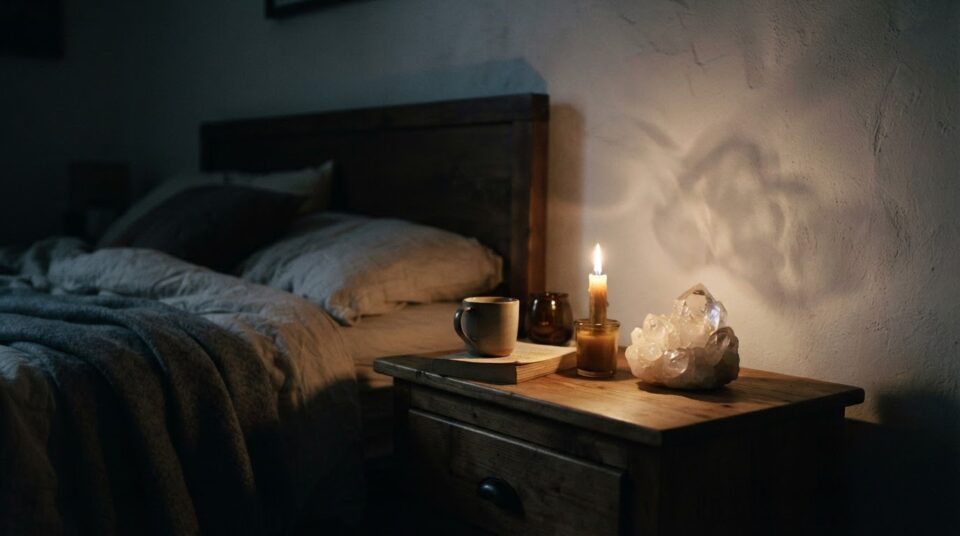
Get a piece of clear quartz — this will be your gatekeeper’s physical home, not just a nice stone on your nightstand. Before you use it for anything, ask the stone itself whether it’s willing to work with you in dream and spirit work. Don’t assume yes — this is a real consent question, not a formality.
Once you have that consent, set up at your altar, light a candle, and set your intention: you want to meet your dream gatekeeper or dream teacher. Then journey, and once you’re in, state that intention again — you’re here to meet your dream gatekeeper or dream teacher. A spirit will come forward and offer to work with you. It doesn’t have to be the spirit of the quartz itself; the stone is simply where you’ll house this relationship going forward, not necessarily who you’re meeting.
A spirit will come forward and offer to work with you. Once it does, ask it three things:
- What is your name?
- How are we going to work together?
- How do I honor you?
That third answer is the one that varies — the spirit might ask for incense, a daily prayer, a glass of water left out each night, or something else entirely. Whatever it asks for, that’s the deal: you’re building a relationship, not just issuing a request. Honor it the way it asks to be honored.
The nightly practice. Once the relationship is set, keep that piece of clear quartz on your nightstand. Every night before bed, speak the spirit’s name into the stone, tell it you’re getting ready to sleep, and ask for its gatekeeping and protection through the night. This same method isn’t limited to gatekeeping, either — the stone-and-relationship structure works for any spirit partnership in your dream work, whether that’s protection, dream recall, or something else you’re working toward.