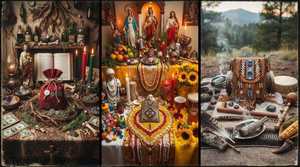
Portable magick isn’t a modern invention. Long before charm bags showed up in a metaphysical shop, cultures around the world were creating ways to carry protection, intention, and blessing with them wherever they went. Hoodoo, born in the American South from West and Central African traditions carried across the Atlantic under unimaginable conditions, gave us the mojo bag and the gris-gris. In Haiti, Vodou practitioners crafted the paket wanga, a wrapped bundle built in relationship with the spirits. In Cuba, Santeria, or Lucumi as its practitioners call it, developed the resguardo and the macuto amulet, tied to the Orishas. Across North America, Native peoples carried medicine bags and sacred bundles, believed to hold protection, guidance, and power. High in the Andes, the Q’ero people of Peru wove kintu pouches to carry prayers close to the body. And in the Appalachian mountains, granny magick blended herbs with scripture into trick bags and asafoetida charms worn for protection. Even the witch’s sachet and the spell jar, more rooted in European folk magick, are part of this same universal human instinct, to take our magick with us.
Hoodoo (Mojo Bag & Gris-Gris)
Culture: Hoodoo is an African American spiritual and folk-magick tradition, born among enslaved people in the American South and passed down through generations since. It carries forward and reshapes older African spiritual knowledge into something new, forged specifically out of the experience of slavery and survival in the Deep South, from Louisiana through Alabama, Mississippi, and Georgia.
What they created: two closely related but distinct carried charms, the mojo bag and the gris-gris bag, both descended from West and Central African conjure traditions. Origin: the practice traces to the Kongo people of Central Africa and the Mandingo people of West Africa, carried into the Americas during the transatlantic slave trade and blended in the South with elements of Indigenous and European folk practice.
Mojo bag: typically a small flannel pouch, most often red, though color varies by purpose, filled with a minimum of three ingredients — herbs, roots, stones, or curios. Sometimes called a mojo hand, toby (Maryland-Delaware region), a nation sack (Memphis-Mississippi area), or a conjure hand, trick bag, or root bag elsewhere in the South. Described by practitioners as a prayer in a bag, meant to be carried on or close to the body and fed with oils or spirits over time to keep its power active.
Gris-gris bag: more specifically tied to Louisiana Voodoo, sharing the same African root word for charm or fetish. Unlike the mojo bag, which is almost always carried, a gris-gris can also be placed at a location or used for distance work, and often carries more ceremonial or Catholic-influenced elements from its New Orleans context.
Haitian Vodou (Paket Wanga)
Culture: Haitian Vodou, a religion born among enslaved Africans in the French colony of Saint-Domingue, later Haiti, blending West and Central African spiritual traditions, particularly from the Fon and Kongo peoples, with elements of Catholicism forced onto enslaved practitioners under colonial rule. It survived colonization and went on to play a role in the Haitian Revolution, the only successful slave revolt in history to establish a nation.
What they created: the paket wanga, sometimes spelled paquet or wanga packet. Origin: the word wanga itself is African in origin, meaning charm or spell, related to the same root behind gris-gris.
How it’s used: a paket wanga is a wrapped bundle built from herbs, roots, dirt, oils, and other sacred materials, bound in fabric and ribbon, with each one entirely unique. It’s created in direct relationship with a specific Lwa, the spirits central to Vodou practice, and made for a specific purpose or situation rather than as a general-purpose charm.
Santeria/Lucumi (Resguardo & Macuto Amulet)
Culture: Santeria, a religion that developed among enslaved Yoruba people in Cuba, blending Yoruba spiritual tradition with Catholicism imposed under Spanish colonial rule. The name Santeria, meaning way of the saints, was actually coined as a mocking term by Spanish colonial authorities. Practitioners’ own name for their faith is Lucumi, from the Yoruba greeting oluku mi, meaning my friend, which is the term worth honoring here.
What they created: two distinct carried charms, the resguardo and the macuto amulet, both tied to the Orishas, the divine forces of Yoruba spiritual tradition. Origin: both descend directly from Yoruba practice, carried to Cuba during the transatlantic slave trade and adapted to survive under forced Catholic conversion.
Resguardo: a protective talisman made using herbs and blood, created in direct contact with the otanes, the sacred stones that house the Orishas. Resguardos are often given specifically to small children, considered especially vulnerable to sorcery.
Macuto amulet: made from cowrie shells and seed beads, prepared for a specific Orisha and colored to match that deity. Meant to be carried, not worn, so the practitioner walks through daily life under that Orisha’s guidance and protection. When not being carried, it’s kept fed with offerings or spiritual waters. We carry cowrie shell amulets in-store at Raven Moon Emporium, if you’d like to see one in person.
Native American (Medicine Bags & Sacred Bundles)
Culture: Native American traditions, spanning many distinct nations across North America, each with its own specific practices, though certain forms of carried sacred items appear widely across tribes. It’s worth noting upfront that this isn’t one single unified culture but hundreds of distinct nations, each with their own names, materials, and meanings for these practices.
What they created: the medicine bag, also called a medicine bundle, alongside larger sacred bundles kept by families or communities. Origin: these practices are old, with some historians tracing similar carried-object traditions back thousands of years, and they developed independently across many different nations rather than from one single source.
Medicine bag: a personal pouch, often made from tanned deerskin or elkskin, carrying an item from each of the plant, animal, and mineral kingdoms, along with anything else believed to bring protection, guidance, or good fortune to its owner. Traditionally treated as deeply personal, no one else was permitted to open another person’s bag, and losing one meant a serious loss of personal power and standing.
Sacred bundle: larger in scale and kept by a family or the wider community rather than one individual, holding ceremonial objects tied to specific rites and traditions, passed down and cared for across generations.
Andean/Q’ero (Kintu Pouch)
Culture: the Q’ero, a Quechua-speaking Indigenous people living high in the Andes mountains of south-central Peru, considered by many to be direct descendants of the Inca. Central to their worldview is ayni, the principle of reciprocity, a constant give and take between people and the living energies of nature.
What they created: the kintu pouch. Origin: woven from alpaca yarn in the traditional pattern of the sun, this small, palm-sized pouch is worn around the neck by Andean priests known as paqos, and grew out of the broader Q’ero practice of the despacho, a ceremonial offering to the earth.
How it’s used: a kintu itself refers to a set of three coca leaves, believed to carry prayers, wishes, and intentions unconditionally. The wearer breathes a heart-centered intention or gratitude into the kintu, then carries it in the pouch throughout the day, blowing into it again whenever they wish to renew the prayer. Eventually, that offering is returned to the earth, placed under stones, in water, or at a sacred site, completing the cycle of reciprocity at the heart of Q’ero spirituality.
Appalachian Granny Magick (Trick Bags & Asafoetida Bags)
Culture: Appalachian folk magick, often called granny magick, developed among the Scots-Irish and German settlers of the Appalachian mountains, blending old-world folk practice with deep Protestant Christian faith. Because the region was so strongly Protestant, most practitioners of granny magick wouldn’t have called what they did witchcraft at all — many of their charms wove together herbs with prayers, psalms, and Bible verses.
What they created: trick bags and asafoetida bags. Origin: these grew out of the region’s isolated mountain communities, developing alongside Hoodoo in the American South and trading influence with it over time, while remaining very much their own distinct tradition rooted in European settler folk practice.
How it’s used: trick bags were small charm bags built for a specific purpose, much like their Hoodoo cousins, but often carrying scripture or a whispered psalm rather than a spirit-feeding practice. Asafoetida bags specifically were small pouches of the pungent herb asafoetida, commonly worn around the neck, especially by children, believed to ward off illness by keeping it at a distance.
European Folk Magick / Witch’s Sachet
Culture: European folk magick, and its modern descendant, eclectic witchcraft, draws on a patchwork of distinct regional traditions across the continent. Rather than one single culture, this covers many separate peoples, each with their own names for the practice. The ancient Romans gave newborn boys a bulla, a locket-style pouch worn around the neck from birth, holding protective charms — often a small phallic symbol called a fascinum, believed to ward off evil — and Roman girls wore a similar pendant called a lunula, shaped like a crescent moon, until their wedding day. The Greeks and Romans both used the broader term amulet, from the Latin amuletum, alongside periapt, from the Greek, meaning something fastened around the body for protection. In Celtic and Druidic tradition, myth tells of the crane bag, a treasure pouch of sacred and precious items, a legend that later inspired the modern witch’s crane bag used to carry ritual tools. Slavic folk practice favored simpler carried charms, like a stitch of red thread sewn into clothing as a barrier against misfortune.
What they created: the witch’s sachet. Origin: sachets descend from this broader European tradition of carrying protective and lucky objects on the body, adapted over centuries and, eventually, into modern eclectic witchcraft.
How it’s used: a witch’s sachet is a small cloth bag filled with herbs, stones, and other correspondences chosen to match an intention, worn or carried much like its counterparts in the other traditions covered above.
Build Your Own Power Bag
Modern, personal-practice bags are what we call “power bags” here — a culturally-neutral term chosen deliberately, so we’re not borrowing language from any one of the traditions above. Here are three ways to build your own.
Personal Power Bag
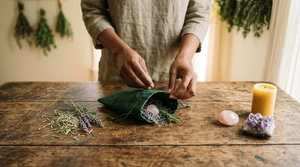
Create a personal power bag, a modern twist on the medicine bag. This isn’t about replicating any one tradition exactly — it’s about creating a personal pouch that reflects who you are and where your power comes from. Fill it with herbs you already work with in your own practice, small carved animal figures to represent the spirit animals or allies you feel connected to, and any small object that reminds you of your own strength. A clear quartz is always a good addition too — it amplifies whatever else is in the bag and supports clarity and spiritual connection. Choose a natural material for the bag itself when you can, leather or cotton rather than anything synthetic, so the container itself stays in harmony with what’s inside it. The goal isn’t imitation, it’s sovereignty — a bag that reinforces your power, built by you, for you.
Job Interview Power Bag
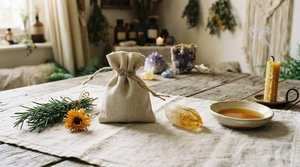
A great example of a power bag built for a specific goal is one for a job interview. This bag works in three ways. First, include something to help you communicate clearly and confidently, so your words come out as strong as your ideas. Second, add something to boost your courage, because when you’re feeling genuinely courageous, you’re far less likely to trip over your words or second-guess yourself in the room. Third — and this one matters just as much as landing the job — include something that sharpens your discernment, so you’re able to ask the right questions and see past the shiny parts of the offer, the travel, the perks, the title, to really evaluate whether this position is actually the right fit for you.
Self-Love Power Bag
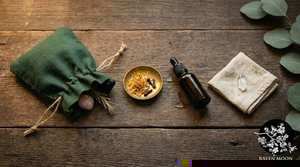
Create a self-love power bag. This one shifts inward, supporting whatever kind of self-love you’re actually working on, since that looks different depending on what you’re healing. Choose your crystal based on the specific work: rose quartz is a wonderful choice for general, everyday self-love. If you’re moving through grief, rhodochrosite or pink calcite are better suited to that particular healing. And if you’re recovering from trauma, rhodonite can be a strong ally. Write down your intention or goal on a small piece of paper and tuck it into the bag, so the bag holds not just the energy but the specific thing you’re working toward. Round it out with herbs that support the heart and your deeper purpose: rose for a better relationship with yourself, hawthorn berry to open the heart, and rosemary to help you find your purpose.
Carry It With You
Magick doesn’t only happen at home or on your altar. It’s something you can carry with you every day, through whatever you’re facing.